IMEI 1 vs. IMEI 2: What’s the Difference and Which Should You Use?
IMEI 1 vs. IMEI 2: Which Number Should You Use?
Jul 15, 202610 min read
Author:
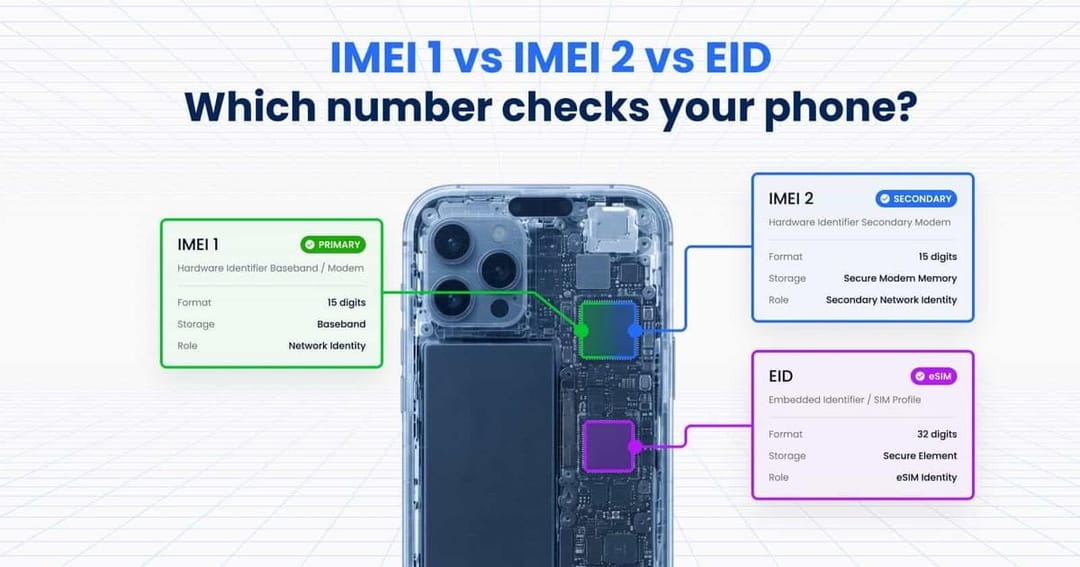
IMEI 1 and IMEI 2 are two different identifiers for the same dual-SIM phone. IMEI 1 is usually the primary IMEI used for device, blacklist, and SIM lock checks, while IMEI 2 is assigned to the second cellular line, often an eSIM.
The EID is different from both IMEI numbers: it identifies the eSIM chip, not the phone’s cellular modem.
Navigating the landscape of mobile hardware identifiers requires understanding the distinction between physical network connections and digital subscriber profiles. Device manufacturers engineer contemporary cellular modems to handle multiple distinct network routes simultaneously. You need a dedicated serial number for every active pathway a device establishes with a cellular tower. The International Mobile Equipment Identity system assigns a unique 15-digit code to each distinct baseband transceiver inside your handset. When you decide to evaluate a used device before a private purchase or sort a bulk shipment for a refurbishment business, you run into a cluster of technical acronyms displayed in the settings menu. Determining exactly which string of numbers to query against unlocking servers directly impacts the accuracy of the background history report you receive.
How Many IMEI Numbers Does a Modern Phone Have
Most contemporary smartphones feature exactly two IMEI numbers to support Dual SIM functionality. Devices operating exclusively with a single physical SIM slot and no eSIM capabilities will only have one IMEI.
The introduction of Dual SIM Dual Standby architecture revolutionized how cellular modems authenticate on mobile networks. In the past, hardware manufacturers physically installed two distinct SIM card trays into devices aimed at international markets. Today, the configuration is largely digital. A modern handset typically contains one physical tray and one embedded universal integrated circuit card. Because the cellular modem maintains the ability to connect to two different network operators simultaneously, the GSMA standard requires the hardware to broadcast two separate identities. If you possess a device manufactured after 2018, inspecting the settings or dialing the universal USSD code will almost certainly reveal a pair of 15-digit serial numbers. Phones designed for specific enterprise use cases or older budget models lacking virtual profile support remain the exception, relying on a single identifier.
What Is the Difference Between IMEI 1 and IMEI 2?
IMEI 1 represents the primary network transceiver tied to the first physical SIM slot, while IMEI 2 corresponds to the secondary transceiver usually allocated for an eSIM or a second physical slot. Both numbers share the same core device identity but manage separate network connections.
The distinction between the two identifiers comes down to hardware routing prioritization inside the logic board. Manufacturers program the primary slot to serve as the default communication channel for cellular provisioning. When a device powers on and searches for a network, the baseband processor initiates the initial handshake using the first serial number. The secondary identifier remains dormant until you insert a secondary physical card or download a digital profile from an operator. They typically share the same 8-digit Type Allocation Code (TAC), since both identify the same device model, but have different serial number sequences (SNR) — and therefore different check digits as well.
Feature Comparison
IMEI 1
IMEI 2
EID Number
Hardware Binding
Primary physical SIM tray
Secondary physical tray or eSIM
eUICC secure element chip
Primary Function
Main cellular network authentication
Secondary standby network routing
Digital subscriber profile storage
Global Registry
Master record in GSMA database
Subordinate network identifier
Not logged in carrier blacklists
Format Length
15 numeric digits
15 numeric digits
32 numeric digits
User Action Required
Hardware check and SIM lock status
Virtual network activation
Carrier profile download mapping
Which IMEI Number Should You Use: IMEI 1 or IMEI 2?
Use IMEI 1 for a standard device, GSMA blacklist, and SIM Lock check unless the carrier or checker specifically asks for IMEI 2. IMEI 2 is the secondary identifier and may be used for the phone’s second SIM or eSIM line.You must always use IMEI 1 when performing a GSMA status or carrier SimLock check. Global carrier databases and unlocking servers index the primary IMEI as the master record for the entire device.
Querying a device's history requires hitting the exact database entry that original equipment manufacturers provide to the GSMA registry at the time of factory production. Carriers attach financial holds, lost or stolen reports, and network lock policies directly to the primary hardware identifier. If you input the secondary number into a validation tool, the application programming interface might return a "Not Found" error or deliver an incomplete status report, misleading you into believing a blacklisted phone is entirely clean. Private buyers aiming to avoid stolen property and resellers processing hundreds of units for overseas export rely on the master record to secure their investments. You can verify your device's exact status by inputting your primary 15-digit code directly into the active checker form provided on this page.
Expert Tip from IMEI.best: "Always cross-reference the digital primary 15-digit code displayed in the operating system settings with the physical number laser-engraved on the SIM tray or internal chassis. A mismatch instantly indicates a refurbished phone assembled with unauthorized replacement parts, posing a massive risk for sudden network blacklists."
What Is an EID Number and How Does It Relate to eSIM
An EID is not the same as an IMEI. The EID identifies the phone’s embedded eSIM chip, while IMEI 1 and IMEI 2 identify the cellular modem pathways used by the device. The EID is a unique 32-digit serial number physically embedded into the phone's eUICC chip, which stores digital eSIM profiles. Unlike a 15-digit IMEI that identifies the modem to the network, the EID identifies the secure element chip capable of holding multiple virtual SIM cards.
Hardware engineers developed the Embedded Identity Document to serve as an unalterable serial code for the integrated circuit soldered directly onto the motherboard. When you transition away from disposable plastic chips, the network requires a hyper-secure digital vault to transmit subscriber credentials over the air safely. The 32-digit string acts as the permanent mailing address for this secure vault. Whenever you request a new line of service from a USA telecommunications provider, their servers encrypt the digital subscriber profile and route it specifically to your hardware's embedded identity. The baseband processor then decrypts this package and maps it to the secondary transceiver logic.
Technical Specification
IMEI Structure
EID Structure
Total Character Length
15 digits
32 digits
Registry Standard
3GPP and GSMA
GSMA SGP.22
Prefix Designation
8-digit Type Allocation Code
5-digit GSMA eUICC identifier
Calculation Method
Luhn algorithm for check digit
Cryptographic sequential assignment
Modifiable via Software
Stored in secure, tamper-protected modem memory
Hardcoded into secure element
Which IMEI Number Do You Use for eSIM Activation
For eSIM activation, the carrier may ask for IMEI 2 and the EID, but the exact requirement depends on the device and carrier. IMEI 2 identifies the secondary cellular connection; the EID identifies the eSIM chip that receives the digital profile. You need to provide IMEI 2 along with the EID number to activate an eSIM on most modern cellular networks. IMEI 2 is specifically designated by manufacturers to handle the digital profile downloaded into the embedded chip.
Navigating the activation funnel for major USA carriers requires providing precise hardware routing information to their automated provisioning systems. When you initiate an activation portal, the operator asks for the secondary 15-digit code because it acts as the designated digital bridge. The embedded 32-digit chip receives the encrypted file, but the secondary baseband transceiver actually executes the transmission to the cellular tower. Providing the primary code during a digital activation often causes systemic conflicts, as the carrier's network switch attempts to push a virtual profile to a physical tray that cannot accept digital downloads. Ensuring you supply the correct secondary sequence prevents activation failures and delayed network handshakes.
Dual SIM Dual Standby (DSDS) Architecture: How IMEI 1, IMEI 2, and the EID Chip Connect
What Is the IMEI Number of a SIM Card
A SIM card does not have an IMEI number; it has an ICCID, which is a 19 or 20-digit serial number identifying the chip itself. The IMEI is strictly tied to the phone's hardware modem, while the ICCID belongs exclusively to the subscriber identity module.
This represents one of the most common technical misconceptions in consumer electronics. The integrated circuit card identifier acts as your personal account number with the telecommunications provider, linking your specific billing details and phone number to a physical piece of plastic. You can move this plastic between entirely different handsets, and your phone number follows you. The 15-digit hardware identity remains permanently fused to the specific phone chassis. Telecom operators pair these two distinct identifiers on their backend servers to authorize network access. When you report a device stolen, the carrier blacklists the hardware identity to render the physical phone useless, while issuing you a new subscriber chip to retain your phone number.
Baseband Analytics and Hardware Network Identity
Baseband processors manage radio communications and handle the complex routing between multiple hardware identities and a single embedded chip. Understanding this architecture reveals how cellular modems isolate data streams to prevent network conflicts.
Deep engineering analysis reveals that modems utilize a single baseband processor to multiplex dual identities through a process called time-division multiplexing. The processor rapidly switches network requests in milliseconds, creating the seamless illusion of two distinct simultaneous network streams without requiring dual independent radio antennas.
Another engineering reality involves the storage capacity of the embedded integrated circuit. The architecture allows a user to store up to eight separate digital subscriber profiles concurrently within the secure element. Despite this high storage capacity, the baseband logic gate enforces a strict limitation, allowing only one virtual profile to interface with the secondary transceiver at any given moment to prevent cellular interference.
The validation of these hardware identities relies on a mechanical computing concept from the 1950s known as the Luhn algorithm. The baseband logic uses this mathematical formula to calculate the fifteenth check digit of the hardware sequence, ensuring that switching centers instantly reject accidental typos before wasting processing power on an invalid network request.
Device Authentication Strategies for Resellers and Buyers
Verifying hardware integrity requires checking the master IMEI against international databases to uncover hidden carrier locks or financial holds. Bulk refurbishers and private buyers rely on this specific identifier to guarantee secure domestic and overseas transactions.
Sorting bulk pallets of used electronics demands a rigorous operational protocol. Companies specializing in reverse logistics extract the master 15-digit code to automate their quality assurance pipelines. Running this specific identifier through an application programming interface instantly separates clean inventory destined for prime marketplace resale from devices burdened with unpaid carrier balances. This distinction is critical for export markets. Devices carrying USA financial holds function perfectly on international networks in Latin America or Dubai, but selling a domestic network-locked unit to a local buyer results in an immediate refund request. Private consumers utilize exactly the same strategy on a micro scale, demanding the master serial code from independent sellers to run an independent background check before transferring funds.
GSMA Database Mechanics and Blacklist Propagation
Network operators utilize an automated synchronization protocol to ensure that a blacklist status applied to IMEI 1 immediately cascades to IMEI 2. This prevents users from bypassing a carrier block simply by switching to a secondary SIM slot or downloading a new eSIM profile.
When a network administrator flags a device for fraud or non-payment, the original equipment manufacturer's registry broadcasts an update to the central global database. The database architecture groups all hardware identifiers assigned to a specific logic board under a unified master node. Blocking the primary physical pathway triggers an automated script that instantly poisons the authorization token for the secondary pathway. Attempting to circumvent a domestic block by downloading a prepaid digital profile onto the secondary transceiver fails immediately, as the core baseband routing table inherits the restricted status globally. This unified security protocol protects the integrity of the secondary handset market and neutralizes the value of compromised hardware.
%2520Hardware%2520Architecture.jpg&w=1080&q=80)