Financed Phone Blocked for Unpaid Bills: AT&T, T-Mobile, Verizon
Financial Blocks from AT&T, T-Mobile, and Verizon: How Do They Work?
Aug 21, 20266 min read
Author:
A financial block is a hard network restriction triggered when an original purchaser defaults on their device installments or service bills. The carrier flags the device’s International Mobile Equipment Identity (IMEI), boots it off the cellular network, and turns a $1,200 piece of hardware into a Wi-Fi-only paperweight.
AT&T, T-Mobile, and Verizon phone financial blocks due to unpaid bills.
Buying a used phone online is a gamble against hidden carrier debt. You buy a spotless device, swap your SIM, and it works flawlessly for weeks. Then the signal flatlines. Restarting won't fix it. A new SIM won't fix it. The original owner stopped paying their bills, and the carrier severed the connection.
The mechanics of a carrier block
Carriers use the IMEI to enforce debt collection. Modern flagship phones are expensive, so carriers push zero-interest Equipment Installment Plans (EIPs). The customer pays sales tax upfront and signs a 24- or 36-month financing agreement. Until that balance hits zero, the carrier holds a financial lien on the hardware.
When an account defaults, the carrier’s billing system pings their internal network database. The network switches immediately reject any authentication request from that specific IMEI. The device will power on and run apps over Wi-Fi, but the cellular baseband is locked out.
Equipment Installment Plans act as unsecured consumer loans tied to a physical device. If you buy a phone from someone mid-contract, you are buying hardware partially owned by a telecom giant. The debt stays with the account holder, but the lien stays with the phone.
The secondary market has a massive blind spot here. A phone carrying an unpaid balance looks and acts exactly like a fully paid-off phone—right up until the moment the carrier drops the hammer.
Timeline of a carrier financial block after a seller defaults on an installment plan.
AT&T, T-Mobile, and Verizon enforcement policies
AT&T, T-Mobile, and Verizon all use the IMEI as leverage, but their enforcement timelines and unlocking protocols differ. Every carrier runs a private Equipment Identity Register (EIR) to control network access. If the billing system flags an IMEI for non-payment, the EIR blocks it.
Carrier
Typical Time to Block
Network Restriction Scope
Unlock Policy Nuances
AT&T
30 to 60 days post-default
Restricts AT&T and its direct MVNOs
Requires fully paid off status to unlock
T-Mobile
45 to 90 days post-default
Aggressive local network ban
Requires active service and zero balance
Verizon
Until balance is paid in full
Local suspension
Auto-unlocks after 60 days regardless of debt
AT&T's network lock
AT&T treats the hardware and service as a single package. They refuse unlock requests if the device carries any installment balance. If a seller defaults, AT&T blacklists the IMEI on its native network and across all Mobile Virtual Network Operators (MVNOs) using AT&T towers, including Cricket Wireless and Boost Mobile.
T-Mobile's local blacklist
T-Mobile’s billing system swiftly moves defaulting devices to an internal negative database. They demand a zero balance and 40 days of active service before authorizing an unlock. A blocked T-Mobile phone is useless on their native network and associated MVNOs like Mint Mobile or Metro.
Verizon's changing unlock policy
Until January 2026, an FCC mandate forced Verizon to automatically unlock devices 60 days after activation, regardless of the installment balance. This created a well-known loophole: a seller could finance a Verizon phone, wait two months for the automatic unlock, and resell it - even mid-payment. In January 2026, the FCC granted Verizon a waiver ending this rule due to widespread fraud abuse. Verizon now requires the device to be fully paid off before it will unlock a postpaid phone, and prepaid devices unlock only after 365 days of active service - bringing Verizon in line with AT&T and T-Mobile.
If a seller defaults on their Verizon bill, Verizon suspends the IMEI on its own network and its MVNOs, like Visible. Because unlocking now depends on a paid-off balance rather than a fixed 60-day window, a phone bought mid-financing is far more likely to stay locked to Verizon than it was before 2026 — making it harder, not easier, to use on a competing network.
Why the market is flooded with financed phones
Sellers offload financed phones to exploit the gap between the point of sale and the carrier's automated enforcement. Some are just broke consumers liquidating their newest asset for cash. They might intend to keep paying the bill, but they eventually default.
Others run systemic fraud rings. Scammers use stolen identities to open accounts, finance dozens of flagship phones for zero down, and dump them on Facebook Marketplace or Craigslist. They pocket the cash and vanish. Weeks later, the carrier realizes the first bill is dead and blocks every associated IMEI simultaneously. You are left holding the consequences of their fraud.
Under the hood: Local blocks vs. global blacklists
Diagnosing a network failure requires understanding the difference between a local carrier block and a global GSMA blacklist. They are entirely separate systems.
The local Equipment Identity Register handles billing disputes. If you stiff AT&T, they drop your IMEI into their private blocklist. They don't share this financial data with T-Mobile US or Vodafone UK. The hardware is simply banned from AT&T's infrastructure.
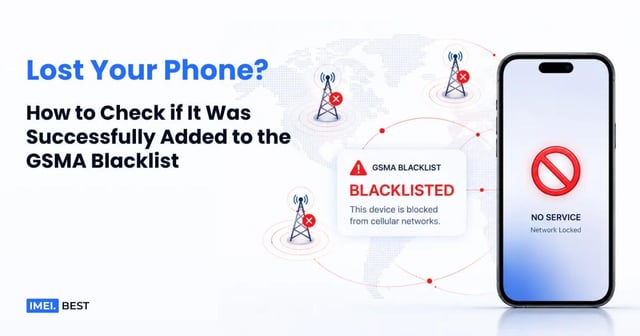
The GSMA IMEI database, on the other hand, tracks stolen hardware. If a phone is reported stolen to police, the carrier uploads the IMEI to this central registry. Almost every legitimate carrier worldwide downloads this list and programs their local switches to reject the device globally.
Carriers rarely upload purely financial blocks to the GSMA database. A defaulted loan is a civil contract dispute, not a criminal theft. This architectural gap explains why a financially blocked US phone often works flawlessly if exported and sold overseas, fueling a massive international gray market for financed electronics.
Can you pay off the seller's debt?
No. Carriers will not let a secondary buyer clear a financial block.
When you call customer support with a blocked IMEI, the rep sees the original account on their screen. They will ask for the account PIN or the last four digits of the original owner's SSN. Because you aren't the account holder, they will flatly refuse your money. Their contract is with the original buyer. If the seller ghosts you, the phone remains permanently locked out of the network.
Pre-purchase verification and checking the IMEI
Every phone has an IMEI, accessible in the settings or by dialing *#06# on the dialpad. Verifying this serial number is your only defense before handing over cash.
At IMEI Best, our developers see this scam constantly. Our platform can verify device models, check specs, and ping the global GSMA blacklist to ensure the hardware isn't reported stolen. But no independent third-party website has real-time API access to the private billing servers of AT&T, T-Mobile, or Verizon.
A phone can pass a basic IMEI check today simply because the seller paid last month's bill. Next month, when they skip the payment, the carrier will kill the connection. The only foolproof method to avoid hidden debt is to meet the seller at a physical carrier retail store. Have a store representative run the IMEI through their internal point-of-sale system to confirm the device is fully paid off before you complete the transaction.
%2520from%2520AT%2526T%252C%2520T-Mobile%252C%2520and%2520Verizon_%2520How%2520Do%2520They%2520Work_.webp&w=1080&q=80)
%2520from%2520AT%2526T%252C%2520T-Mobile%252C%2520and%2520Verizon_%2520How%2520Do%2520They%2520Work_%2520(1)%2520(6).webp&w=1080&q=80)